Sunday, August 21, 2011

FishingEnthusiast.com's July Fly of the Month: Emergent Sparkle Pupa


July 2011
FishingEnthusiast.com’s
Fly of the Month
Emergent Sparkle Pupa


Excerpted from the book: Trout Flies, Proven Patterns. By Gary LaFontaine

What is my most original creation? On four points, the Emergent Sparkle Pupa. Some sharp historian might find precedents for three of the points, the the fourth one, the most important, can safely be called an innovation (for obvious reasons). The technique of dubbing the underbody, the Touch Method, creates a sparser, fuzzier covering than any other method of dubbing. The trick of a 'loose' overbody is unusual even now. The Emergent, half in and half out of the water, is the first caddis pupa designed to mimic the hesitation of the escaping natural at the surface film.

The underbody has to be "touch" dubbed. The dubbing mix of half sparkle yarn and half fur is hand-cut in 1/8-inch lengths, and then blended together in a mixer. The tier holds a puff of this specially prepared dubbing and pats the waxed thread lightly. He wraps the thread on the hook shank. No other method of dubbing, - not noodle dubbing and not loop dubbing - creates such a sparse, fuzzy body.

The overbody, plies of sparkle yarn pulled forward to envelope the underbody, has to be loose and sparse. A size 10 hook uses a full ply of yarn on top and a full ply of yarn on the bottom on the shank. On smaller sizes the tier pulls more and more fibers off of the plies. Each ply is combed completely out and spread over the top or bottom half of the hook shank. The tier loosens the overbody with a scissors point or a dubbing needle (the puffed out "ball" fills half of the hook gap). For the final test the tier holds the finished fly up to the light. He should be able to see the underbody through the overbody; he shouldn't be able to see any light or solid bands of yarn.

Materials: Emergent Sparkle Pupa
Hook:  6-20 (standard dry fly, TMC 100).
Thread:  To match underbody.
Overbody:  Sparkle yarn.
Underbody:   Half sparkle yarn and half fur (a finely chopped dubbing blend).
Wing:  Deer hair.
Head:  Dubbed fur or wrapped marabou fibers.

Happy Fishing!
Www.FishingEnthusiast.com

July Saltwater Lure of the Month: Johnson Silver Minnow

July 2011
Johnson Silver Minnow
Saltwater Lure of the Month

The ingeniuous and deceivingly simple Johnson Silver Minno was born of necessity in 1920 by Louis Jackson. Frustrated by the thick late-summer weed beds in his local lake, Johnson began to tinker in his spare time in search of a solution. The eventual result was the very first Silver Minnow, designed by Johnson to feel right at home in thick vegetation where other lures simply failed to perform.  Starting with the business end of a tablespoon, Johnson added a hook and a simple weed guard to complete his early prototype. Yet even with these rather clever modifications to the spoon, the lure was still not quite what Johnson was looking for.

Eventually, Johnson began to forge an oblong spoon-shaped lure from a copper/zinc alloy. He designed the prototype to be thicker in the middle than at the edges and a bit more elongated than his original tablespoon creation. Johnson’s reengineered design put the weight along the center of the lure.  This kept the single hook ridding upright and giving the lure a side-to-side wobbling action. The vertical position of the hook actually enhanced the weedless characteristics of the spoon and the wobbling action added tantalizing fish-attraction. Still the choice of fisherman– in saltwater and freshwater alike– around the world for over 75 years after its introduction, the silver minnow has earned its “classic” status the old fashioned way. Johnson’s spoon as caught fish after fish in all types of conditions for decades.

Featured lure: Johnson’s Silver Minnow
Created by: Louis Johnson
Created: 1920
Manufacturer: Johnson Outdoors, Inc.


Technique:
Cast the Silver Minnow directly into or around weed beds and other forms of natural cover. Often a slow, steady retrieve will produce the most consistent results. But don’t hesitate to experiement with the rate and pattern of your retrieve. 

And lastly, enjoy the beautiful water around you!


Happy Fishing!


July Freshwater Lure of the Month: Chug Bug

July 2011
Chug Bug
FishingEnthusiast.com’s
Freshwater Lure of the Month
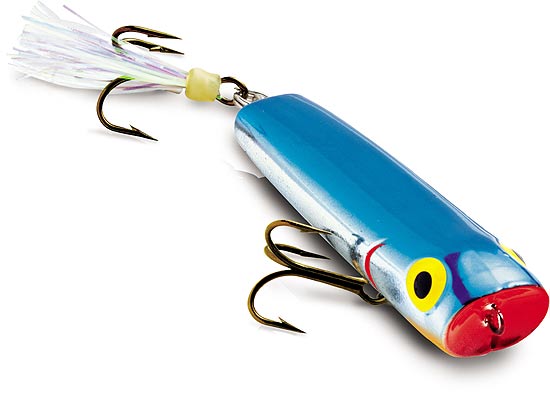
Storm Lures rightly touts their sensational Rattlin Chug Bug as a lure for all species of fish when they're feeding on the surface. “From panfish to snook” as they put it.  Founded in Oklahoma, Storm’s been manufacturing innovative lures since the 1960’s. Their first lure was the ThinFin, which began shipping in the 1960’s. About twenty years later, Storm introduced the enclosed topwater sensation. The Chug Bug comes from a long line of successful lures including Storm’s Thunderstick, Wiggle Wart, and Hot ‘N Tot, to name just a few. Normark, makers of the legendary Rapala lures, recently acquired Storm. We believe that Storm is now stronger and more innovative than ever.
The versatile Chug Bug is a favorite of professional and amateur anglers because it can be fished as a popper or as a surface chugger. Bass and walleye anglers find the Chug Bug to be very effective when fished in smaller sizes at night. Oklahoma pro Tom Morton has had success fishing the Chug Bug with a high-speed technique. Morton ties the line at the bottom of the line-tie (without a snap or split ring) and fishes the lure “real, real fast”. This technique makes the Chug Bug spit and skip wildly because the nose is kept unusually high in the water due to the position of the knot. The technique provokes explosive strikes according to Morton, who won the 1992 Oklahoma Invitational with many copies of this lure in his tackle box. Anglers can currently choose from three sizes of Chug Bugs dressed in dozens of colors.

Featured Lure: Chug Bug

Created: C. 1980’s

Manufacturer: Storm Manufacturing

Type: Topwater Plug

Technique:
Experiment with your retrieve. Anything goes with top water lures, i.e. Tom Morton’s high-speed technique. That having been said, the most often mentioned retrieve associated with the Chug Bug is a splash-and-stop technique. Cast the Chug Bug out. Let it settle quietly on the water. Wait some more. With your rod tip down so the wind doesn’t catch your line, give your Chug Bug a solid pull to create its fish attracting splash. Then wait. Let the lure rest a good long time in a motionless position before repeating. The most vicious strikes often occur just after the Chug Bug begins to move again.

Want to join the fun? Visit www.FishingEnthusiast.com and sign up a friend for the Freshwater Lure of the Month Club!

Wednesday, June 29, 2011

June Walleye Lure of the Month: Flatfish


Walleye Lure of the Month: Flatfish


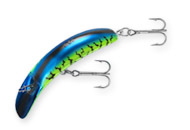
In the fall of 1933, Charles Helin unveiled an unorthodox creation to the fishing community.  Helin fittingly named his lure the FlatFish, and it eventually proved worthy of his effort.  The "banana-style" lure’s fierce side-to-side action and unique shape has earned the FlatFish a secure place in fishing history.  So secure a place, in fact, that the FlatFish has become among America’s best selling lures of all time.  According to the manufacturer, an impressive 40 million of their lures have been sold to date.  Over the decades the FlatFish has produced trophies representing the entire spectrum of game fish found in both streams and lakes. 

Over the past seventy years, the FlatFish has grown from a single prototype, that Charles Helin first turned out on a home lathe, to a vast line of high quality fishing lures.  The FlatFish comes in sizes ranging from a modest one-inch lure to a mammoth six-inch muskie version.  There are fourteen different FlatFish sizes in all.  The FlatFish is also no slouch when it comes to color combinations; no fewer than ninety-four variations are available, including four new "Fire Tail" colors: Lime, Chartreuse, Tutti-Frutti, and Hot Fire Tail.

Featured lure: FlatFish
Created by: Charles Helin
Created: c. 1933
Manufacturer: Yakima (current manufacturer)

Technique:
The Flatfish will produce the best results when fished slowly.  A slow retrieve will ensure that the lure realizes its now famous side-to-side wobbling action.   Be sure to tie the Flatfish directly to your line.  A small snap can be used, but a snap-swivel is not recommended.


June Saltwater Lure of the Month: Luhr Jensen's Krocodile Spoon

Saltwater Lure of the Month: Luhr Jensen's Krocodile Spoon

The Krocodile spoon was created by Luhr-Jensen, a world class company with humble beginnings.  The company was founded by Luhr Jensen, Sr. in 1932 in an unused chicken coop on a depression-ridden fruit ranch in the upper Hood River Valley of Oregon.  In the words of Luhr, “Things were simpler then. We made a few different styles of spinners and had special relationships with our Northwest jobbers.  Everyone was “your friend”… it was not a bad time”. 
In 1932, Luhr was 41 years old and his family’s fruit growing businesses was struggling.  With some extra time on his hands, Luhr began stamping and assembling very carefully made, hand crafted salmon spinners.  His fishing knowledge and careful craftsmanship helped to create a very high quality lure.  Before he knew it, friends and associates started demanding his lures.  And so, a little factory was born in his little backyard chicken coop factory.
With the help of his wife and his son and daughter after school, the business grew and prospered.  Luhr was the lead creator, and the kids then replicated his creations.  Most of Luhr’s earliest creations can still be seen in some evolved form today, such as the Ford Fender, named after the Model A from which he obtained the headlight reflector and built the blades.
Luhr Sr. has long since passed, but 70 years later the company is as strong as ever. His lures today are still made in only the highest quality, just as Luhr always wanted.

How to fish the Krocodile Spoon
The Lurh Jensen Krocodile spoons are used by both shore and boat anglers for salmon, steelhead, and other species. The spoon can be cast, trolled, or run off a downrigger. They have a swivel with split ring in front and a single treble hook in the rear.
The spoon can be used casting, trolling, or with a jigging action.  Also performs well with a wounded bait fish action.  Very heavy duty and with saltwater resistant hooks, this spoon can be used for a long time and has been known to catch everything from bass, yellowtail, barracuda, and bonitos to even yellowfin and halibut.
Happy Fishing and Good luck!


FishingEnthusiast.com's Lure of the Month Clubs Featured in Canada's WalletPop.com!


FishingEnthusiast.com got some great press from our friends at WalletPop in Canada over Father's Day! They put together a slideshow of Father's Day Gifts that Dad Will Thank You For.  They note Father's as one of the toughest members of the family to buy for, but have created their presentation so you no longer have to buy him that old tie or coffee mug! Insert FishingEnthusiast.com to solve your shopping woes!


Here is what they had to say about us:

Lure of the Month Club
David Hasebroock is using his Omaha, Nebraska-based website, Fishing Enthusiast, to finally make shopping for your fisherman father easier than ever with the Lure and Fly of the Month Clubs. When it comes to lures, you can pick either fresh water or salt water lures and each one comes in its own gift box that includes a note on the history of the lure in question. On the day the three, six or 12 month subscription is purchased, a fishing gift card will be sent to dad along with a personal note from you. Premium lures such as the Chug Bug, Husky Jerk and Deep Baby N are mixed in with every subscription. Prices range $53 to $180 for their most popular Freshwater lure subscription and shipping is free to Canada.


Thanks WalletPop!!

June 2011 Freshwater Lure of the Month: Zara Puppy

June 2011 FishingEnthusiast.com Freshwater Lure of the Month: Zara Puppy

Originally Named After 
Pensacola's Red-Light District

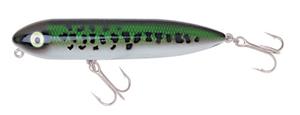
The Zara Spook was invented in Pensacola, a seaport in NW Florida, on Pensacola Bay, in 1922 and sold by Heddon, a  company formed in 1894.  This seductive lure with its trademark wiggle was originally called the Zaragossa, aptly named after the "wiggling" women on Zaragossa Street, which at the time was Pensacola’s red-light district.  A few years later the lure was given a new design (1939) and the name was forever changed to the Zara Spook.  The latter portion of its new name was inspired by the skeleton-like design painted along the sides of the first version of this popular lure. 

To this day the Zara Spook remains one of the most often fished lures of all time along with its smaller offspring, the Zara Puppu.  In fact, even after all of these years and despite its enormous success, the Zara Spook and Zara Puppy’s left-to-right, right-to-left top water action remains unique in the marketplace.  This 'walk the dog' motion pulls even the most stubborn game fish from the bottom when no other lure can.  The now classic lure enclosed is crafted from plastic, but the original was hand-carved from white cedar.  Not to worry, today’s  Zara  is as deadly as the original.

Lure:  Original Heddon Zara Puppy
Size:  4 1/2"
Weight:  3/4 oz
Current Manufacturer:  EBSCO Industries, Inc

Technique:

Cast the Zara Spook out into likely cover, let it rest long enough for the ripples to disperse.   With your rod tip at a 30 degree angle from the water, begin twitching the lure from side to side with an occasional short pause to induce its trademark 'walk-the-dog' style action.