Wednesday, June 29, 2011

FishingEnthusiast.com Featured on CNBC.com!


FishingEnthusiast.com was recently featured on CNBC.com as the top gift to give for Father's Day 2011!  What a tremendous honor and sales were through the roof!  Thanks CNBC!


Here's what CNBC.com had to say about FishingEnthusiast.com:

If dad lives to fish, you might want to sign him up for a fishing lure of the month club. Fishing Enthusiast has several different ones. Pick the one that fits his favorite fishing spot or his favorite catch. There are lures for trout, walleye, saltwater and fresh water. 
Thanks CNBC!

June Freshwater Fly of the Month: Tungsten Zebra Midge


The FishingEnthusiast.com's Freshwater Fly of the Month: the Tungsten Zebra Midge


This nifty little midge imitation was developed, not by one tyer, but by a group of local fly fishers who call the richly beautiful Lee’s Ferry area of Northern Arizona home.

Originally called the Lee’s Ferry Midge, this little silver wire ribbed and bead-headed creation has been fished successfully from the Four Corners area of America’s western frontier through the Pacific Northwest, Alaska, and even into the northern reaches in British Columbia.

Umpqua Feather Merchants’ Tungsten Zebra Midge sports a heavy tungsten bead head for increased sink rate and an attractive underwater profile. The neatly tapered thread body is topped with a contrasting ribbing of silver wire and bushy dubbing fibers form a realistic set of wiggly pro legs. When tiny midges make up nearly a fifth of the common trout’s diet in any water on the globe, this is a fly no angler should be without!

Specifications:
    A fantastic fly pattern developed in Northern Arizona’s Lee’s Ferry region, tied professionally by Umpqua Feather Merchants
    Midge imitation in the mature larval life stage
    Fishes effectively in all types of trout water
    Dead drift through slower water and eddies
    Faster riffles and current seams can also be great spots to dead drift a midge larva pattern
    Midges are often most effectively fished when attached as a dropper to a larger nymph or when fished just below the water’s surface with a large dry fly as a strike indicator
    Because of the common and widespread nature of midge species, trout anglers ought to keep a wide selection of midge fly patterns in their fly boxes
Tungsten bead head provides extra weight needed to fish deep pools and fast riffles or runs

Follow the Fishing Enthusiast on Twitter @FishEnthusiast!

Tuesday, May 17, 2011

How Much is Enough?


This is the story sent out to all subscribers this month!  A great read. Taken from the wall at a Jimmy Johns, believe it or not.

How Much is Enough?

The American businessman was at the pier of a small coastal Mexican village when a small boat with just one fisherman docked. Inside the small boat were several large yellow-fin tuna. The American complimented the Mexican on the quality of his fish and asked how long it took to catch them. The Mexican replied only a little while. The American then asked why didn't he stay out longer and catch more fish? The Mexican said he had enough to support his family's immediate needs. The American then asked, but what do you do with the rest of your time?

The Mexican fisherman said, “I sleep late, fish a little, play with my children, take siesta with my wife, Maria, stroll into the village each evening where I sip wine and play guitar with my amigos, I have a full and busy life, senor.”

The American scoffed, “I am a Harvard MBA and could help you. You should spend more time fishing and with the proceeds buy a bigger boat with the proceeds from the bigger boat you could buy several boats, eventually you would have a fleet of fishing boats. Instead of selling your catch to a middleman you would sell directly to the processor, eventually opening your own cannery. You would control the product, processing and distribution. You would need to leave this small coastal fishing village and move to Mexico City, then LA and eventually NYC where you will run your expanding enterprise.” The Mexican fisherman asked, “But senor, how long will this all take?” To which the American replied, “15-20 years.”

“But what then, senor?”

The American laughed and said that’s the best part. When the time is right you would announce an IPO and sell your company stock to the public and become very rich, you would make millions.

“Millions, senor? Then what?”

The American said, “Then you would retire. Move to a small coastal fishing village where you would sleep late, fish a little, play with your kids, take siesta with your wife, stroll to the village in the evenings where you could sip wine and play your guitar with your amigos.”

Wednesday, April 20, 2011

April Freshwater Lure of the Month: The Apex Tackle Game Fish from Cabela's


The Apex Tackle Game Fish from Cabela's

Technique:
Extremely versatile and effective, The Apex Game Fish Spoon is a must for every fisherman's tackle box. Whether long casted, trolled, or vertically jigged these spoons produces an excellent wide, wobbling action that entices thunderous strikes from a vast array of freshwater gamefish.

Features:
  • wide wobbling action
  • Classic tear drop shaped
  • Color: Chartreuse w/ orange spots
  • Weight: 7/8 oz


The History of Cabela’s
Cabela’s was founded, by chance, in 1961. Dick Cabela managed his parents’ small furniture store in Chappell, Nebraska.  In January of ‘61, Dick and his father went on a product-buying trip. At the Navy Pier Housewares Show in Chicago, a small back-corner booth that was marketing inexpensive Japanese fishing equipment caught Dick’s attention.  Dick convinced his father that he could sell the flies they were selling ($2.25 a gross) around the furniture store, so they purchased 20 gross (2,880 flies) for $45.

Several months later, not a single fly had sold. It hit Dick that he needed to start advertising. His first ad read, “12 hand-tied fishing flies for $1, postage paid.” Only Mrs. Ernest Lindahl of Casper purchased a package of flies. With nothing to lose, Dick pulled out another ad in Field and Stream magazine that read, “5 hand-tying fishing flies… FREE. 25 cents postage and handling.” Dick knew “free” was a powerful marketing tool and he was right.  That day they received 25 orders.

Bolstered by new potential, Dick took out ads in many other magazines with the same ad, greatly increasing his customer base with the attraction of free fishing flies. Realizing the value of his new customer database, Dick scrambled and purchased hooks, lures, reels, and bamboo fly rods and put together Cabela’s first catalog to send out to his new loyal (and growing) following.. 

By the Spring of ‘62, Cabela’s small business outgrew his pantry and moved to the shed in the backyard.  But it didn’t stop there. The business grew to dozens of other buildings before locating to Sidney, NE in ‘73. With a customer first approach, Cabela’s has continued to grow, and now has a 120,000 foot world headquarters in Sidney.  The company now has
over 14,000 employees and was ranked No. 1 in the outdoor retailer industry in 2006.  And that catalog that Dick originally put together in his basement?  Now that catalog has 500 plus pages and is sent to 130 million consumers in all 50 states and 125 countries every year.  Not bad for a guy that just wanted to sell some flies out of his furniture store!


    Tuesday, April 19, 2011

    April Saltwater Lure of the Month: The Kastmaster

    Kastmaster
    April 2011
    Saltwater Lure of the Month
    ^Check them out! Many great lures!

    The Kastmaster is a popular and deadly spoon-type lure for both fresh and salt water. Many anglers use this lure or know about it. But very few anglers know the story of Art Lavallee, the man who discovered and perfected the Kastmaster and put it on the market.

    Art Lavallee was born in Providence, Rhode Island in 1918, and as a young boy liked freshwater fishing. After returning from W.W. II where he served on submarines in the Pacific, he resumed freshwater fishing and in 1947 he caught an 8 3/4 lb. largemouth bass that held the Rhode Island state record for many years. But when he caught his first striped bass in the ocean, striper fishing became his primary fishing interest.

    In 1949, Art Lavallee and his brother Al formed the Spencer Plating Company, which polished and electroplated jewelry. Art took some of the jewelry and bent and changed their shapes to create metal fishing lures. He and his friends enjoyed successful angling results with these inventions, so Art decided to enter the fishing tackle business and founded the Acme Tackle Company in 1952. Then Art learned about a lure called the EDA Splune developed by the Engineering Design Associates. This metal lure was the forerunner of the Kastmaster. The Acme Tackle Company entered into a royalty agreement with EDA and acquired the rights to market the lure. Art field tested the lure and then modified it, making it longer and giving it the jewelry like finish for which Acme lures are famous.

    The Kastmaster was quickly accepted by both fresh and saltwater anglers and is now used to catch all kinds of fish. An amazingly versatile lure, the Kastmaster is equally deadly whether cast, trolled, or vertically jigged. It casts like a bullet, and its unique side-to-side darting action is something which pursued baitfish do, but which ordinary spoons do not.

    Wednesday, April 6, 2011

    March Saltwater Lure of the Month: Striper Strike


    March 2011

    Saltwater Lure of the Month
    STRIPER STRIKE
    Right out of the box, Creek Chub’s Striper Strike had quite a lot to live up to.  After all, Creek Chub has manufactured several of the most celebrated lures over the last eighty-plus years that it has been in business.  Most notably, the Wiggle Fish.  Created in the early 1900s, this modest plug was once the world-record largemouth bass holder.  The Striper Strike had to fight other influential Creek Chub lures such as the Pikie Minnow, the Injured Minnow and the Darter for its share of the spotlight.  The Pikie Minnow, perhaps Creek Chub’s most popular lure, was released in both a solid-bodied and jointed model.  We were told that among the jointed model’s more notable achievements is a 69-pound muskie caught in the St. Lawrence River.  Many muskie fisherman, naturally, continue to reach for the Pikie Minnow first and last.  We’ve heard that the Striper Strike elicits the same reaction from saltwater anglers.

    Most lures manufactured today are made from plastic.  That’s true of this month’s selection, although Creek Chub originally carved their lures from wood.  Originally, for example, the Pikie Minnow was carved by hand from white cedar.  As white cedar became a bit more rare and expensive, other woods were used.  Creek Chub eventually moved its entire line to plastic production.  It would be hard to argue that today’s Creek Chub lures are less effective than their wooden predecessors.  As far as plastic baits go, Creek Chub’s tremendously high standards ensures that their product is among the finest available.  In the hand, wooden baits have quality and heft no modern plastic lure can match, but Creek Chub has created an incredibly durable, surprisingly satisfying lure in the Striper Strike.

    Featured lure: Creek Chub Striper Strike
    Manufacturer: Creek Chub, an EBSCO Industries company
    Type: Sinking, surface popper/chugger
    Technique: 
    “As soon as it hits the water, start a fast erratic retrieve that makes the lure skip and skitter on the surface to resemble a fleeing shad.  Remember, a smaller lure sometimes draws more strikes.”

    Join the fun! Enroll the special fisherman in your life in the Saltwater Lure of the Month Club! A great fishing gift for the fisherman that has everything!

    March Freshwater Lure of the Month: Jitterbug


    March 2011
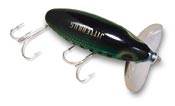
    Jitterbug
    In 1932, Fred Arbogast was out fishing with his friends and experimenting with creating his own lure with some leftover supplies he had.  After a few go’s at it, Fred created a metal minnow that he called the Tin Liz, which as he described it was “the most natural cripple ever made”. His friends thought so, too, and demanded he share his newly created lure.  Word spread quick, and all of the sudden the Tin Liz was in such hot demand across the country that Fred decided to create his own fishing lure company, Arbogast Lures.

    Fred experimented with many different lures over the next five years, but didn’t hit it big time until 1938 when he created the now infamous Jitterbug.  There probably isn’t a bass fisherman alive who hasn’t heard of or used the famous Jitterbug. The wobbling surface bait immediately captured the attention of the fishing fraternity when it was introduced. As soon as the Jitterbug hit the water, letters of praise from enthusiastic fishermen began pouring in to Fred. Fishermen throughout the country wanted to share their successes with the inventor, and his company quickly outgrew his basement.

    Fred’s business philosophy was based on his belief that one must be a fisherman to understand and respond to the needs of other fishermen. He designed each lure to solve specific fishing problems he encountered, and developed one of the most popular lure companies in America. Arbogast lures have been in the business for 75 years, and have that very first Tin Liz for its creation, and the Jitterbug for vaulting Fred into the spotlight.

    The Freshwater Lure of the Month is a great gift to send to the Fisherman who has everything! He will love this fishing gift!