Wednesday, November 10, 2010

Bayou Boogie vs. Rebel Crawfish


BAYOU BOOGIE      vs                       REBEL CRAWFISH

Which of these great lures should be the November Freshwater Lure of the Month? Vote on the right!

Monday, October 25, 2010

FE October Trout Fly of the Month


Tying The Zonker Minnow Fly Pattern
Hook:Tiemco #300 size 4 (any long shank streamer hook, sizes #2-#8)
Thread:Olive&White 6/0
Weight:Large lead wire
Underbody:White antron dubbing
Body:Pearl mylar piping
Wing/back:Olive Zonker strip
Hackle:Dyed olive grizzly marabou

How to tie the Zonker:

Many tiers omit the hackle, or use red to suggest the swollen gills of an injured bait fish. Some use marabou as a beard, instead of a hackle. A strip leech is a Zonker tied with a marabou tail (like a wooly bugger), gold or silver sparkle chenille wound as a body, and copper or brass wire to bind down a zonker strip on top. As you can see, there are many flies that owe their fundamental design to the Zonker…and for good reason. The rabbit strip pulses, breathes as it is stripped. It undulates, and seems to never stop moving. Once you see rabbit fur under water, any doubt you may have in it quickly disappears.
In the original pattern, adhesive lead tape is used over the top of the hook shank and taped to itself on the underside. It is then trimmed to the body shape of a minnow before the mylar piping. I tie some this way, but have found that once a good-sized fish (trout or bass) gets a grip on that tape underbody, it deforms it. The problem is that the mylar piping fibers often get pulled apart to some degree. In the pattern below, lead wire is used (strong, tight) with a smooth, dubbed body over it. This "holds" the shape of the mylar and gives a bit when the fish takes. I believe that the fish holds on just a bit longer when it bites a soft body.


Happy Fishing!

FE Saltwater Lure of the Month: Zara Puppy


FE Saltwater Lure of the Month: Zara Puppy

The Zara Puppy was originally created by Heddon, a fishing company started in 1894.  In the early 1900's the "walk the dog" technique began to take off in popularity, so Heddon knew they wanted to keep up with the technique, creating their Zara Puppy model. These lures are designed to allow you to control the lure's action, much like that of the Zara Spooks.  It takes a little practice, but once you get it down, these lures have a reputation for attracting fish from as far as 20 feet away and the strikes are vicious!

The Three L's: Lob, Lift, Lead and Set
"Lob the cast. With a short line loading the rod downstream using water tension to cast, form a tent with the rod and fly line. Raise and rotate the rod hand and in a chopping motion, drop the forearm toward the target (usually slightly upstream). This will allow the flies to sink to the desired depth. After the cast 'lift' the rod horizontally so all or most of the line to the indicator is off the water, leaving a slight bit of slack for a natural drift. Lead the tip of the rod above or slightly downstream of the indicator. This position will help with the hook set. (When thinking of lead, think about 'Walking a Dog'. If the leash is too tight, you are choking the dog. If it is too loose, the dog can get out of control.)" The hook set is when the indicator does anything other than drifting naturally, such as slowing, dipping, pausing....When in doubt, quickly set the hook downstream by moving your rod tip towards the water. This will pull the hook into the trout's mouth and keeps the rig in the water and not flinging in the air. Remember that most tangles happen in the air and not in the water."

Questions or comments? David@FishingEnthusiast.com


October Freshwater Lure of the Month


Fishing Enthusiast Freshwater Lure of the Month: The Little Cleo!

The Little Cleo is a classic among the freshwater casting spoons.  Dating back to 1953, the lure was originally created by the Seneca Lure Company of New York City and was designed for salmon and steelhead anglers in the Great Lakes region.  Seneca lures was founded by Charlie Clark, a man with a very creative personality who began as a songwriter and publisher, only to later in his career get into selling fishing equipment.
As an avid fisherman in upstate New York, Charlie knew that if he could come up with some metal lure designs to take advantage of the growing demands, he could launch Seneca into a major player in the fishing industry.  His most popular lure was designed with a concave, humpbacked shape that Charlie felt wiggled so enticingly that it would be irresistible to any predatory fish that came its way.  Once he had tested the lure, he only needed to come up with a name.
As the story has been passed down over generations, it has been said that Charlie had become secretly enamored with an actress named Rhonda Fleming, the star of a 1951 film called Little Egypt.  The film popularizes a form of dancing that is now widely referred to as “belly-dancing”.  In Charlie’s head, he felt that the enticing, wiggling action of the lure would be as tantalizing to the fish as Ms. Fleming was to him.  So, Charlie wanted to name the lure after the movie, and decided upon “Little Cleo”, which was short for “Little Cleopatra”.  He even went so far as to imprint the image of a belly dancer on the packaging and on the inner concave of some of the Little Cleo’s themselves, his own personal joke.  This practice continued for the next 45 or so years, until the image finally became a casualty of politcally correct sensibilities in the mid-1990’s.    


Questions or comments? Contact me at David@FishingEnthusiast.com!

Tuesday, September 14, 2010

September Freshwater Lure of the Month


Freshwater Lure of the Month
Thunderstick Lure
Many men go fishing all of their lives without knowing that it is not fish they are after. 
~Henry David Thoreau

The Thunderstick lure was originally created by Lauri Rapala in the early 1900’s and was fished off of docks in lakes and ponds.  Little did Lauri know, this lure that she had originally carved out of birchwood would become fine tuned over the years, and with a little added color, would be a mainstay for every pike, walleye, and any other freshwater fisherman out there. 
Currently being manufactured by Storm, these lures are now made with hard plastic that stops the pike from penetrating the lure with its teeth, which can result in a better hookset.  Casting and retrieving slowly will create a natural wiggle that attracts pike.  Thundersticks can be used to troll and to cast.  They are generally meant for water depts. Of 1 to 5 feet.
Rated as a “Top 10 Pike Fishing Lure” by eHow.com, this lure is a must have for any fisherman’s tackle box.

Happy fishing!

Lures are on their way, be on the lookout!

September Trout Fly of the Month!


 September 2010

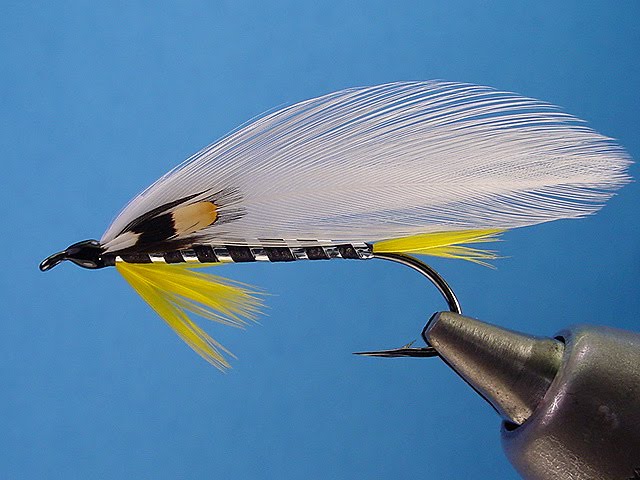
This very popular fly is not as complex as the Gray Ghost but it can be as effective in the right conditions. It originated around 1927 and became one of the classic American Streamer Lures. Herbert ‘Herbie’ L. Welsh is credited with its design. Herbie claims to be the first person to tie streamer flies that developed into the modern day long shanked streamer flies. His original Black Ghost streamer flies were tied on hooks reshaped from bluefish bait hooks. He needed a longer hook that would be better for making smelt imitations so he started to forge his own. The rise in popularity of the fly was the result of Nellie Newton producing them for Percy Tackle Company in Portland, Maine. The original Black Ghost had a Featherwing like our version. Herb had a shop at Haines Landing on Lake Mooselookmeguntic, Maine USA. He was a renowned fly caster, who was often invited to demonstrate his skill at many sporting shows. Herbie was also a well known taxidermist, fishing guide, an artist and sculptor. You can still see some of his bronze sculptures on display today in the Smithsonian's American Museum of Art. The Black Ghost remains as popular and killing a fly pattern today as it was during the depression era of the 30's. It is ideal for steelhead fishing. Its ability to catch fish has lead to it being used for salmon, sea trout and big trout fishing.


FLY TYING PATTERN:

Hook: Streamer 4x-long sizes 2-10 Thread: Black 8/0 or 6/0
Body: Black floss
Tail: Yellow hackle barbs or yarn Hackle: Yellow hen neck, folded back
Wing: White feathers from neck or saddle, use 4 broad feathers
Rib: Flat silver tinsel, palmered

September Saltwater Lure of the Month

The September Saltwater Lure of the Month is the Johnson Silver Minnow!

September 2010
SILVER MINNOW

The Johnson Silver Minnow was first marketed in 1920. The Silver Minnow is thicker in the middle than at the edges. This creates the patented 35-degree wobble. No other spoon is built like this, which is why no other lure has worked so well for so long. It rocks back and forth, but it won’t roll and twist line. And it’s plated with pure silver or 24-kt gold, to produce a brighter flash than chrome or brass spoon.

The hook is hand-soldered to the belly of the spoon, and the lure has a looped wire line-tie eye to which I directly attach my fishing line. The top of the lure has a stout metal prong that is strategically positioned right in front of the hook point, thereby defending it against snags and weeds. A biting fish can depress this prong easily but snags cannot. The spoon has an aerodynamic shape and it casts well.

Rated by Field and Stream Magazine as a “Top 50 Lure of All Time” in 2006, the Johnson Silver minnow is a tackle box necessity. Great for fresh or saltwater, the Silver Minnow can also be enhanced by adding a pork-rind trailer, which will give it that little extra wiggle and drives walleye and bass nuts.

Enjoy your lure!

Lures have shipped and are on their way, be on the lookout!